Why Your Brain Craves the Orchid: The Neuroscience of Botanical Wonder in Island Sanctuaries
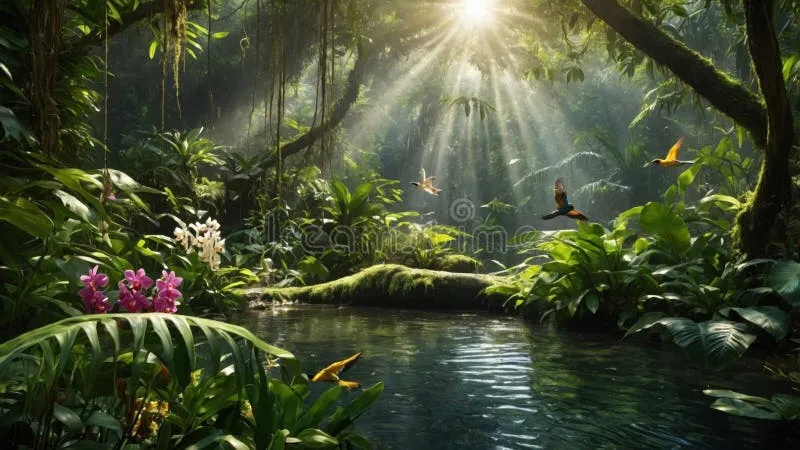
Photo: luxury traveler meditating cloud forest orchid tropical island serene, via thumbs.dreamstime.com
There is a particular quality of silence that settles over a traveler standing inside a cloud forest, face to face with an orchid that exists nowhere else on earth. It is not the silence of absence. It is the silence of arrival — a felt sense that something within the nervous system has, at last, exhaled.
For years, this experience was described in the language of poetry. Now, increasingly, it is being described in the language of neuroscience — and the findings are remarkable enough to reshape how thoughtful travelers approach the question of where, and why, they choose to go.
The Biophilia Hypothesis, Revisited
The biologist E.O. Wilson introduced the concept of biophilia in 1984, proposing that human beings possess an innate, evolutionary affinity for living systems and the natural world. Decades of subsequent research have substantiated and refined this idea considerably. We now understand that exposure to natural environments — particularly biodiverse, visually complex ones — triggers measurable neurological responses that differ meaningfully from those produced by urban or built environments.
What is less widely appreciated is that not all natural encounters are neurologically equivalent. Research published in journals including Environment and Behavior and Landscape and Urban Planning suggests that environments characterized by high species diversity, sensory layering, and what researchers call "soft fascination" — the gentle, involuntary attention drawn by rustling leaves, flowing water, or the intricate patterns of a flower — produce the most pronounced restorative effects on attention and mood.
Orchid-rich island habitats, it turns out, are almost ideally configured to deliver exactly this kind of experience.
What Happens Inside the Brain
When a traveler enters a dense tropical forest or a curated orchid sanctuary on an island like Borneo, Sri Lanka, or Puerto Rico, several neurobiological processes unfold more or less simultaneously.
The prefrontal cortex — the region associated with executive function, decision-making, and the relentless cognitive overhead of modern professional life — begins to quiet. Researchers at the University of Michigan demonstrated this phenomenon through studies showing that time spent in natural settings reduces activity in the subgenual prefrontal cortex, the area linked to rumination and self-referential negative thought. The effect is sometimes described colloquially as "turning down the mental noise."
Concurrently, the brain's default mode network — active during rest, daydreaming, and creative ideation — becomes more accessible. This is the neurological state associated with insight, imaginative thinking, and the kind of lateral problem-solving that structured work environments frequently suppress. Many creative professionals who have undertaken botanical travel report that their most generative ideas arrived not at a desk, but on a forest path, pausing before an extraordinary bloom.
The visual complexity of orchids themselves may play a specific role in this process. The fractal geometry found in natural forms — the branching patterns of ferns, the radial symmetry of flowers — has been shown to reduce physiological stress markers. Orchids, with their extraordinary structural variety and chromatic range, offer an unusually rich source of this kind of visual engagement.
Sensory Immersion and the Chemistry of Calm
Beyond the visual dimension, orchid sanctuaries engage the full sensory spectrum in ways that amplify their neurological impact. The olfactory dimension alone is significant: certain orchid species produce fragrances of remarkable complexity, and research in psychophysiology has consistently linked natural scent exposure to reductions in cortisol, the primary hormonal marker of stress.
The phytoncides released by forest environments — volatile organic compounds emitted by trees and plants — have been studied extensively in the context of Japanese Shinrin-yoku, or forest bathing. These compounds have been associated with increased natural killer cell activity, improved immune function, and elevated mood states that persist for days or weeks following exposure. Island forests, with their layered canopies and extraordinary botanical density, represent some of the most phytoncide-rich environments on the planet.
Humidity, ambient sound, and the physical act of walking on uneven terrain also contribute to what researchers describe as a state of embodied presence — a quality of full-body attentiveness that is the neurological opposite of the screen-mediated, attention-fragmented experience that characterizes daily American life for most of Orchid Isle's readers.
Designing Your Experience for Maximum Effect
Not every orchid encounter is equally transformative. The neurological benefits described above are most reliably produced by experiences that meet certain conditions — and understanding these conditions allows the discerning traveler to choose destinations and itineraries with genuine intentionality.
Duration matters. Brief visits to greenhouse displays, while pleasurable, do not produce the sustained attentional restoration that extended immersion in native habitats generates. Research suggests that a minimum of two hours in a natural setting is required to produce meaningful cognitive recovery; multi-day immersion in biodiverse environments produces effects that compound over time.
Guided, slow-paced exploration outperforms self-directed rushing. A knowledgeable naturalist who draws your attention to specific species, their ecological relationships, and their sensory qualities actively deepens the quality of your engagement — what psychologists call "directed attention" giving way to the restorative "involuntary attention" that characterizes genuine immersion.
Altitude and isolation amplify the effect. Highland orchid habitats — the misty cloud forests of Costa Rica's Monteverde region, the mountain reserves of Taiwan's central range, or the elevated interior of the Big Island of Hawaii — combine botanical richness with reduced sensory pollution from human activity, creating conditions that researchers consistently associate with the most pronounced restorative outcomes.
Disconnection is not optional; it is therapeutic. The neurological benefits of botanical immersion are substantially diminished by the intrusion of digital devices. Luxury operators who build genuine device-free intervals into their itineraries are not simply offering a wellness affectation — they are structuring the experience in accordance with the underlying science.
The Lasting Return
Perhaps the most striking finding in this emerging body of research is the durability of the benefits produced by immersive nature experiences. Unlike the fleeting mood elevation of a spa treatment or a fine meal, the cognitive and emotional changes associated with deep botanical travel have been documented to persist for weeks — and in some cases, to produce enduring shifts in attentional habits, creative confidence, and stress resilience.
Travelers who return from orchid-focused island journeys frequently describe a recalibrated relationship with their own minds: a reduced compulsion toward constant stimulation, a recovered capacity for sustained focus, and a heightened sensitivity to beauty in everyday environments. These are not trivial outcomes. They are, in the language of neuroscience, evidence of genuine neuroplastic change — the brain, rewired by wonder.
At Orchid Isle, we have always believed that the most extraordinary destinations offer more than scenery. The island sanctuaries where rare orchids flourish are, it now appears, also sanctuaries for the human mind — places where the brain remembers, with something very like relief, what it was designed to do.