Unplugged in Paradise: What You Lose When You Chase the Perfect Orchid Shot
Scroll through any travel feed on a given afternoon and you will encounter them — the luminous close-ups of Vanda blossoms suspended against a blurred jungle canopy, the artfully composed flat lays of ghost orchids beside a sweating glass of tropical juice, the golden-hour portraits of a traveler gazing serenely into a sea of violet Dendrobium spikes. The images are, by every aesthetic measure, stunning. They are also, in a meaningful sense, a kind of lie.
Not a deliberate deception, precisely. The flowers are real. The destinations exist. But the curated rectangle of a smartphone screen cannot transmit the warm humidity that settles on your skin the moment you step beneath a forest canopy. It cannot carry the faintly sweet, almost medicinal fragrance of a Maxillaria tenuifolia drifting through still air. It cannot replicate the particular quality of silence that surrounds a centuries-old orchid habitat — a silence so textured it almost hums. These are the elements that define the genuine orchid travel experience, and they are precisely what most visitors, phones raised and lenses focused, are walking straight past.
The Architecture of a Distracted Visit
The behavioral pattern is familiar to anyone who has toured a major botanical garden in recent years. Visitors move through curated collections in a kind of photographic triage, pausing at the most visually dramatic specimens long enough to capture several angles, then moving on. The interaction with the plant itself — its form, its fragrance, the improbable engineering of its pollination structures — becomes incidental to the task of documentation.
Researchers studying visitor behavior at cultural institutions have noted a consistent finding: the act of photographing an object tends to reduce the depth of the memory formed around it. The brain, in effect, outsources the remembering to the device and invests less of its own attentional resources in the experience. Applied to orchid tourism, this means that the traveler who spends forty minutes photographing a rare Cattleya alliance hybrid may retain a sharper digital record than their companion — and a considerably shallower emotional one.
Luxury travelers who have deliberately set aside their devices at island orchid sanctuaries in destinations such as Hawaii, Borneo, and the Lesser Antilles consistently report something that might initially sound counterintuitive: they remember more. The details they absorb — the way a Bulbophyllum blossom trembles almost imperceptibly in a passing breeze, the precise quality of light filtering through a rainforest understory onto a cluster of terrestrial orchids — are retained with unusual vividness precisely because no device was asked to hold them.
What the Algorithm Selects For
Social media platforms are not neutral curators of travel experience. They are, by design, optimized for visual impact, novelty, and the kind of immediate legibility that translates to engagement from an audience scrolling at speed. This has consequences for how orchid tourism is perceived and pursued.
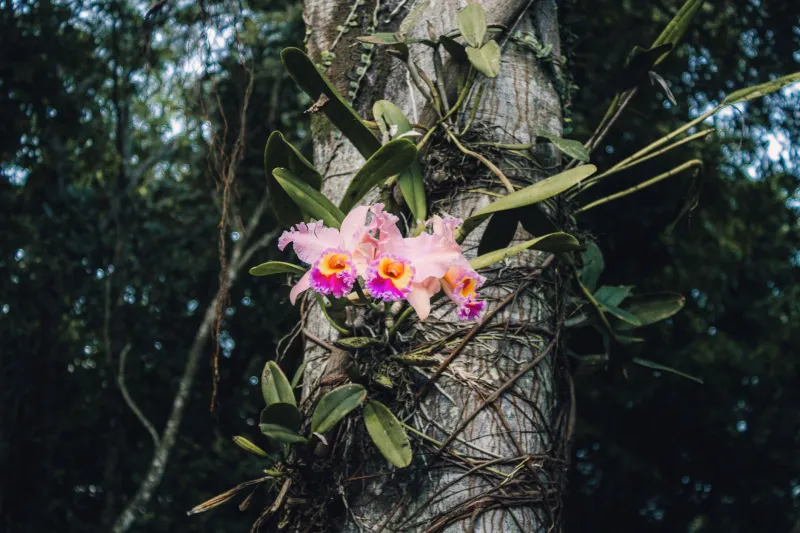
The flowers that perform best on social media tend to be large, boldly colored, and photographable in strong, directional light. The Cattleya and its relatives — showy, theatrical, unmistakably floral — dominate the visual landscape of orchid content. Meanwhile, the species that serious botanists and seasoned collectors regard with the greatest reverence are frequently the most visually understated: the tiny, architecturally complex Pleurothallis relatives of cloud forests, the translucent-petaled jewel orchids of Southeast Asian forest floors, the improbably delicate native orchids of Caribbean limestone karst. These plants require proximity, patience, and a certain willingness to relinquish the expectation of a shareable image. They reward that willingness with encounters that travelers describe, with some consistency, as genuinely moving.
The algorithm, in other words, has engineered a version of orchid tourism oriented almost entirely around a narrow band of spectacular species encountered in highly controlled settings — resort conservatories, festival displays, cultivated show gardens. The wild and the subtle have been largely edited out of the public imagination.
Designing a Journey Around Presence
For the traveler willing to reconsider the terms of engagement, the alternative is not asceticism. It is not a matter of renouncing photography entirely or approaching island orchid destinations with a performative seriousness. It is, rather, a question of sequencing — of deciding when the camera serves the experience and when it competes with it.
Some of the most thoughtful botanical guides working in destinations such as Singapore, Costa Rica, and the Philippine archipelago have begun building explicit "device-free" intervals into their itineraries. These are not enforced as prohibitions but offered as invitations: a thirty-minute period in a particularly significant habitat during which guests are simply asked to engage through their senses rather than their screens. The feedback from participants has been, by most accounts, striking. Guests who were initially skeptical frequently describe these intervals as the most memorable portion of their entire journey.
Practically speaking, designing a presence-centered orchid itinerary involves a few deliberate choices. Selecting smaller-group experiences over mass botanical tours allows for the pace necessary to genuinely observe. Choosing accommodations with access to living orchid collections — private resort gardens, working nurseries, conservation-partnered properties — creates opportunities for unhurried, repeated encounters with specific plants over the course of a stay. Engaging a specialist guide rather than a generalist tour operator shifts the frame of the experience from sightseeing to education, and education demands a quality of attention that photography alone cannot satisfy.
The Transformation That Doesn't Photograph
Travelers who return from immersive orchid journeys frequently struggle to articulate what, precisely, changed for them. The experience resists the neat summarizing that a social media caption demands. What they tend to describe is something closer to a recalibration — a renewed sensitivity to scale, to patience, to the particular beauty of things that exist entirely outside of human intention.
Orchids, after all, did not evolve to be photographed. The extraordinary complexity of their flowers — the precise mimicry of Ophrys species, the elaborate nectar guides of tropical Epidendrum, the astonishing structural variety encoded across twenty-eight thousand species — developed in conversation with specific pollinators, specific habitats, specific pressures accumulated across millions of years. To stand in the presence of that history, genuinely present, is to encounter something that no image file can adequately hold.
The photograph you take of a rare orchid will look, on a screen, very much like thousands of other photographs of rare orchids. The memory of having stood beside one in the humid stillness of its native habitat, having noticed the exact quality of its fragrance and the improbable elegance of its form, will belong entirely and irreducibly to you.
That, ultimately, is what orchid travel at its finest offers — not content, but experience. Not documentation, but transformation. The islands are waiting. The blooms are extraordinary. And they are best encountered, at least for a moment, without the mediation of a screen.