Speaking to the Bloom: How Luxury Travelers Are Finding Stillness Through the Ancient Art of Plant Communion
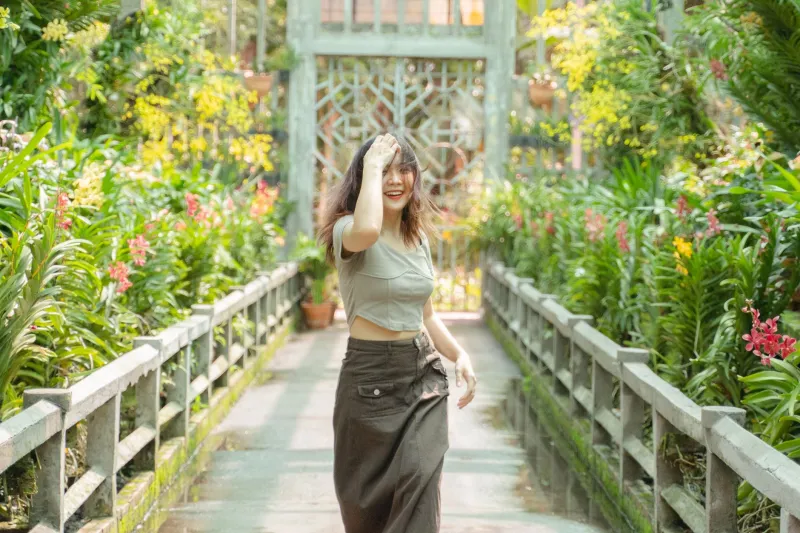
There is a particular kind of silence that falls over a traveler the moment they step into a tropical orchid house at dawn. The humidity wraps around them like a second skin. Color radiates from every corner — violet, ivory, deep magenta — and the air carries the faint, almost imperceptible sweetness of a thousand open blooms. For many visitors, this is where the experience ends: a visual encounter, beautiful and brief.
But for a growing number of luxury travelers, that silence is precisely where the experience begins.
Across high-end botanical retreats in Hawaii, Bali, Sri Lanka, and the Caribbean, resort wellness directors are introducing what they call guided plant communion — structured, intentional sessions in which guests speak quietly, and sometimes aloud, to the orchids in their care. The practice, once considered the exclusive domain of eccentric home gardeners, has found an unlikely audience among America's most discerning travelers. And the science, it turns out, may be quietly validating what those travelers are already feeling.
From Quirk to Curriculum
The notion that speaking to plants produces measurable effects is not new. A 2009 study conducted by the Royal Horticultural Society in the United Kingdom found that plants exposed to human voices — particularly female voices — demonstrated slightly accelerated growth compared to those raised in silence. More recent work in the field of plant bioacoustics has suggested that certain sound frequencies stimulate cellular activity in plant tissue, though researchers are careful to distinguish between acoustic stimulation and anything resembling genuine communication.
Yet the luxury travel industry has never been strictly beholden to peer-reviewed consensus. What matters, resort wellness directors argue, is the effect on the speaker — not merely the plant.
"When we ask guests to slow their breathing, lower their voices, and direct focused attention toward a single orchid, we are essentially guiding them into a meditative state," explains one wellness curator at a boutique botanical resort in Maui. "The orchid becomes an anchor for presence. It asks nothing of you. It does not respond with judgment or expectation. That, for many of our guests, is profoundly unfamiliar territory."
For high-achieving travelers accustomed to environments defined by performance and productivity, this absence of reciprocal demand is, paradoxically, the most disarming luxury of all.
The Neuroscience of Botanical Stillness
Researchers studying the intersection of nature immersion and neurological function have documented what is increasingly referred to as the "attention restoration effect" — the brain's measurable capacity to recover from cognitive fatigue when exposed to natural, non-threatening environments. Orchid gardens, with their layered complexity and absence of urgency, appear to be particularly effective triggers for this restorative state.
When a traveler engages in quiet, directed speech toward a plant, the act compounds these benefits. Speaking slowly and softly requires a conscious regulation of breath and vocal tone. The brain's default mode network — the neural circuitry associated with rumination, self-referential thought, and anxiety — begins to quiet. Attention narrows to a single, non-threatening focal point. Heart rate typically decreases.
In effect, the traveler is not simply talking to an orchid. They are performing a sophisticated, self-directed act of nervous system regulation, mediated by one of the natural world's most structurally extraordinary organisms.
"There is something about the orchid specifically," notes a behavioral wellness consultant who works with several ultra-luxury resort groups across the Pacific. "Its symmetry is bilateral, which the human eye finds deeply satisfying. Its color ranges stimulate different emotional registers. And unlike, say, a rose or a sunflower, the orchid carries very little cultural baggage around sentimentality. It feels ancient and neutral. Guests find it easier to project intention toward something that doesn't already carry a greeting-card association."
Indigenous Roots and Respectful Revival
It would be a disservice to frame this practice as a purely modern invention. Across many of the tropical island cultures that have long coexisted with wild orchid populations — from the indigenous communities of Borneo to the traditional healers of Oaxaca — plants have historically occupied a communicative role in spiritual and agricultural practice. The idea that a human might address a plant with reverence, gratitude, or intention is not eccentricity in these traditions. It is protocol.
The most thoughtful luxury resorts incorporating plant communion into their programming are careful to acknowledge this lineage. Some partner directly with local botanical knowledge-keepers, inviting guests to learn the cultural context of the practice before engaging in it themselves. This framing transforms what might otherwise feel like a whimsical wellness trend into something considerably more substantive: an act of cultural and ecological attention.
For American travelers in particular — accustomed to experiences packaged for efficiency and novelty — this deeper contextualization tends to land with unexpected force. "I came expecting a spa week," one guest at a Hawaiian orchid retreat recently reflected. "I left having had an actual conversation with something I had never considered worth listening to. That is not nothing."
What Luxury Resorts Are Offering
The programming itself varies considerably across properties. At some resorts, guided plant communion is offered as a private, one-on-one session with a resident horticulturalist or wellness specialist — a 45-minute experience in which the guest is introduced to a specific orchid species, learns its origin and ecological role, and is then guided through a structured period of quiet, spoken engagement.
Other properties have woven the practice into broader botanical immersion programs: multi-day itineraries that combine morning orchid walks, afternoon cultivation workshops, and evening reflection sessions in which guests journal their observations and spoken exchanges. A handful of ultra-premium retreats now offer what they describe as "orchid adoption" experiences, in which a guest is paired with a single plant for the duration of their stay, tending to it, speaking with it daily, and receiving a propagation cutting to take home as a living record of the relationship.
The pricing for these experiences reflects their positioning within the luxury market. Dedicated plant communion sessions at top-tier resorts typically run between $150 and $400 per person, while multi-day botanical immersion packages can reach several thousand dollars. Demand, by most accounts, is outpacing availability.
A New Definition of Connection
What this phenomenon ultimately illuminates is a hunger that the conventional luxury travel itinerary — however beautiful, however impeccably curated — has struggled to satisfy. Travelers who have experienced every category of premium service, from private island transfers to Michelin-starred tasting menus, increasingly report that what they crave most is not spectacle but intimacy. Not stimulation but stillness. Not another experience to photograph and share, but one to carry inward.
The orchid, in this context, becomes something more than a botanical specimen. It becomes a mirror — reflecting back to the traveler a version of themselves that is quieter, more patient, and perhaps more willing to listen than their daily lives have allowed.
In the end, the most remarkable thing about speaking to an orchid may not be what the plant receives. It may be what the speaker, at last, begins to hear.